

Clinical Research
Diagnostics and treatment of AML
The AML-BFM reference laboratory has moved to Frankfurt. We will continue to accept TAM/ML-DS samples additional to AML samples for reference diagnosis.
Reference laboratory
Morphology, immunophenotyping and molecular diagnostics
The AML-BFM reference laboratory just moved to the Johanna-Quandt-Centre of the University Hospital Frankfurt. The laboratory is equipped with state-of-the-art flow cytometers (DxFLEX™ from Beckman Coulter), sorters (BD FACSAria™ Fusion) and sequencers to perform high quality morphology, immunophenotyping and molecular diagnostics. The laboratory also performs measurable residual disease (MRD) monitoring using flow cytometry and next generation sequencing, particularly for patients enrolled in the respective studies.
Samples from children with Down syndrome (or trisomy 21) and a suspected or confirmed myeloid neoplasm can be submitted (blood and blood smears, bone marrow aspirates, CSF) to our laboratory for a reference opinion. Additionally, we will from now on also accept samples of all patients with suspected and confirmed AML or myeloid malignancies.
When submitting material, please download and use the new submission form. Please note, that we are not accepting seperate TAM/ML-DS submission forms anymore.
ML-DS 2018 trial
Phase III clinical trial for CPX-351 in myeloid leukemia in children with Down syndrome 2018
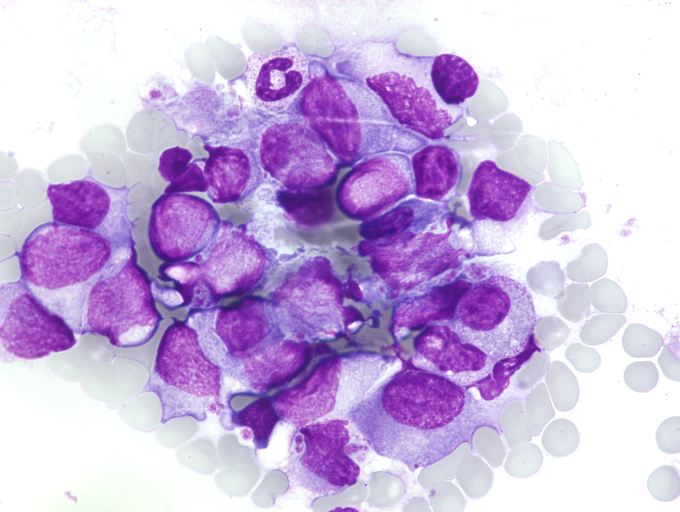
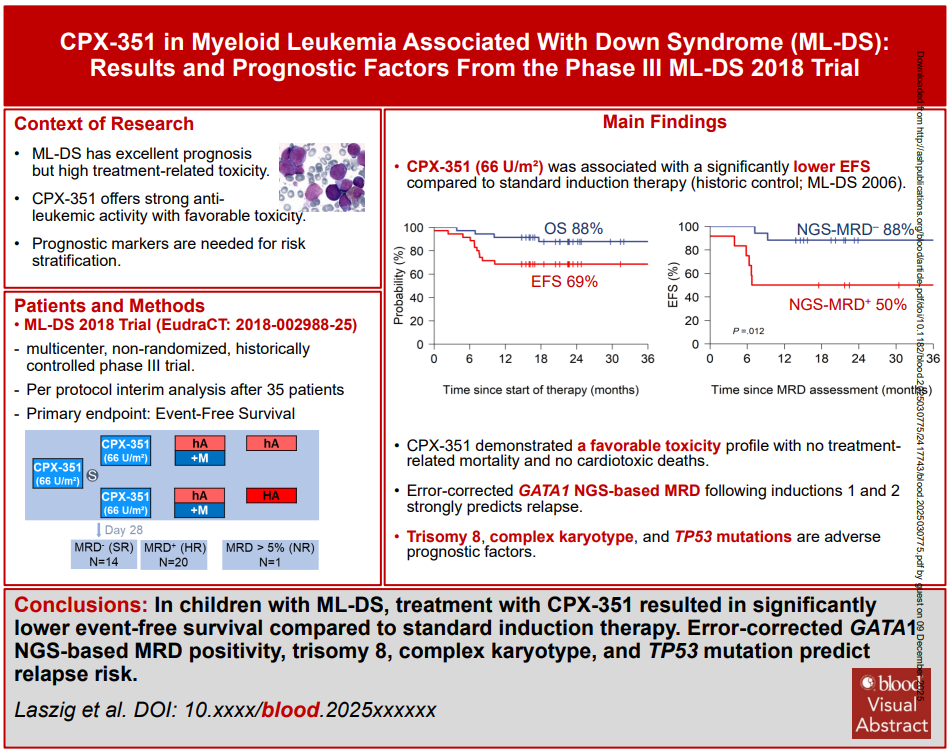
Prof. Dr. Jan-Henning Klusmann is the International Coordinating Investigator of the Phase III Clinical Trial for CPX-351 in Myeloid Leukemia in Children with Down Syndrome 2018 – a prospective, non-randomized, open-label international, and multicenter phase III trial for children with myeloid leukemia associated with Down syndrome (ML-DS). The trial aims to investigate whether substituting the induction of standard ML-DS therapy (as defined in the ML-DS 2006 protocol) with CPX-351, and reducing treatment intensity in course 4 in patients with a good response, can reduce toxicity while maintaining excellent patient outcomes. The reduction of treatment-related toxicity is particularly important for children with Down syndrome, who are very vulnerable to the side effects of intense chemotherapy.
Initial results of the ML-DS 2018 Trial were published, confirming that CPX-351 shows favorable treatment toxicities with no treatment-related mortalities. The trial was temporarily paused, due to an increased number of relapse patients. In contrast to previous studies, most relapsed patients responded to salvage therapy, resulting in a comparable 24-month overall survival. Positive measurable residual disease by error-corrected GATA1 next-generation sequencing, as well as the presence of trisomy 8, a complex karyotype or a TP53 mutation, were predicting factors of an increased risk of relapse.
While there is still a need for dose optimization to balance efficacy and toxicity in this sensitive patient population, the trial has so far shown the beneficial toxicity profiles of CPX-351 and driven the improvement for relapse therapies forward.
Therapy recommendations
Recommendations for the diagnosis and treatment of children with transient abnormal myelopoiesis (TAM) and myeloid leukemia in Down syndrome (ML-DS)
Children with Down syndrome are at a high risk of developing transient abnormal myelopoiesis (TAM) and myeloid leukemia (ML-DS). While most patients with TAM are asymptomatic and go into spontaneous remission without needing therapy, TAM-related complications can be fatal and many patients progress from TAM to ML-DS. ML-DS patients are particularly vulnerable to therapy-associated toxicity, thus ML-DS therapy schemata must strive for a balance between appropriate efficacy and treatment-related toxicity.
We compiled diagnostic and therapeutic guidelines for TAM and ML-DS based on the experience and results of previous clinical studies from the Berlin-Frankfurt-Münster (BFM) working group. These protocols have helped reduce the risk of early death in symptomatic TAM patients using low-dose cytarabine, and achieved excellent cure rates for ML-DS using intensity-reduced treatment protocols.
While primary ML-DS has a highly favourable outcome, refractory and relapse ML-DS so far have an unfavourable prognosis. Therefore we have established the first treatment recommendations for r/r ML-DS, as an effort to improve treatment strategies and the prognosis for these patients.

